
Dear customer,
Thank you for choosing an advanced Prins VSI CNG system for your car. This system complies with strict European standards covering safety and the environment.
It is important that you read and understand this manual.
This digital manual gives you general information about CNG, and explains the Prins CNG VSI system. Scroll down further for information about the fuel selector switch, refueling CNG, fuel consumption, safety aspects, maintenance, troubleshooting, general directives and warranty terms.
Prins wishes you a lot of driving pleasure.

GENERAL INFORMATION FOR DRIVING ON COMPRESSED NATURAL GAS (CNG).
1. As the VSI CNG system starts on petrol, make sure that the fuel tank is not empty or nearly empty. This also prevents the fuel pump from running dry, which could lead to damage to the pump. The petrol in the tank should not be more than 3 months old.
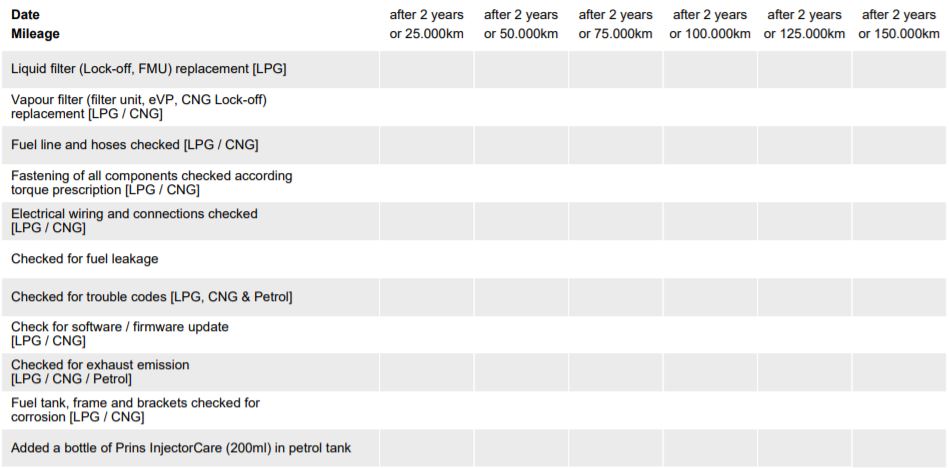
2. For a guaranteed life span and optimal drivability of the VSI CNG system it is necessary to follow the prescribed maintenance. We advise a maintenance check for the VSI CNG system at an official Prins installer every 25.000 km or every 2 years. Check below to find the items for maintenance check.
3. When you smell gas in or around your car, immediately switch over to petrol and have your car checked at the nearest service point.
4. After the installation of your Prins system, you will receive a warranty certificate from your installer. This warranty certificate contains all information about your car and your Prins system. The warranty period starts on the day of conversion.
5. It is generally allowed for CNG vehicles to drive and park in an underground parking space. In some parking spaces there are restrictions imposed by the owner. The owner of the parking space may do that by placing signs at the entrance. These signs have to be respected.
CNG (Compressed Natural Gas)
Natural gas originates like petroleum, from organic material. It is extracted during the extraction of petroleum from petroleum fields and from natural gas fields. A large amount of gas is also released during the refining of crude petroleum. For the use of Natural Gas as an automotive fuel, it is compressed up to 200-250 Bar and stored in a tank hence Compressed Natural Gas. In comparison to petrol and diesel CNG is a clean fuel and its use contributes to a better global environment.
The Prins VSI CNG systeem
VSI is short for Vapour Sequential Injection. The VSI CNG system is based on the sequential injection of vaporous CNG into the engine. ‘Sequential’ means that the CNG injectors apply the CNG in a specific order or sequence which equals the injection sequence of petrol injectors. The system also allows a more precise injection of the mixture, thus complying with the tightened emission regulations. The VSI CNG system is equivalent to the original petrol injection technology and makes optimum use of the electronics already present in your vehicle. This guarantees excellent reliability.
Below you will see the different components that together form our VSI system. The main components are of OEM quality and specially developed for CNG installations. They meet the strictest regulations and certification.
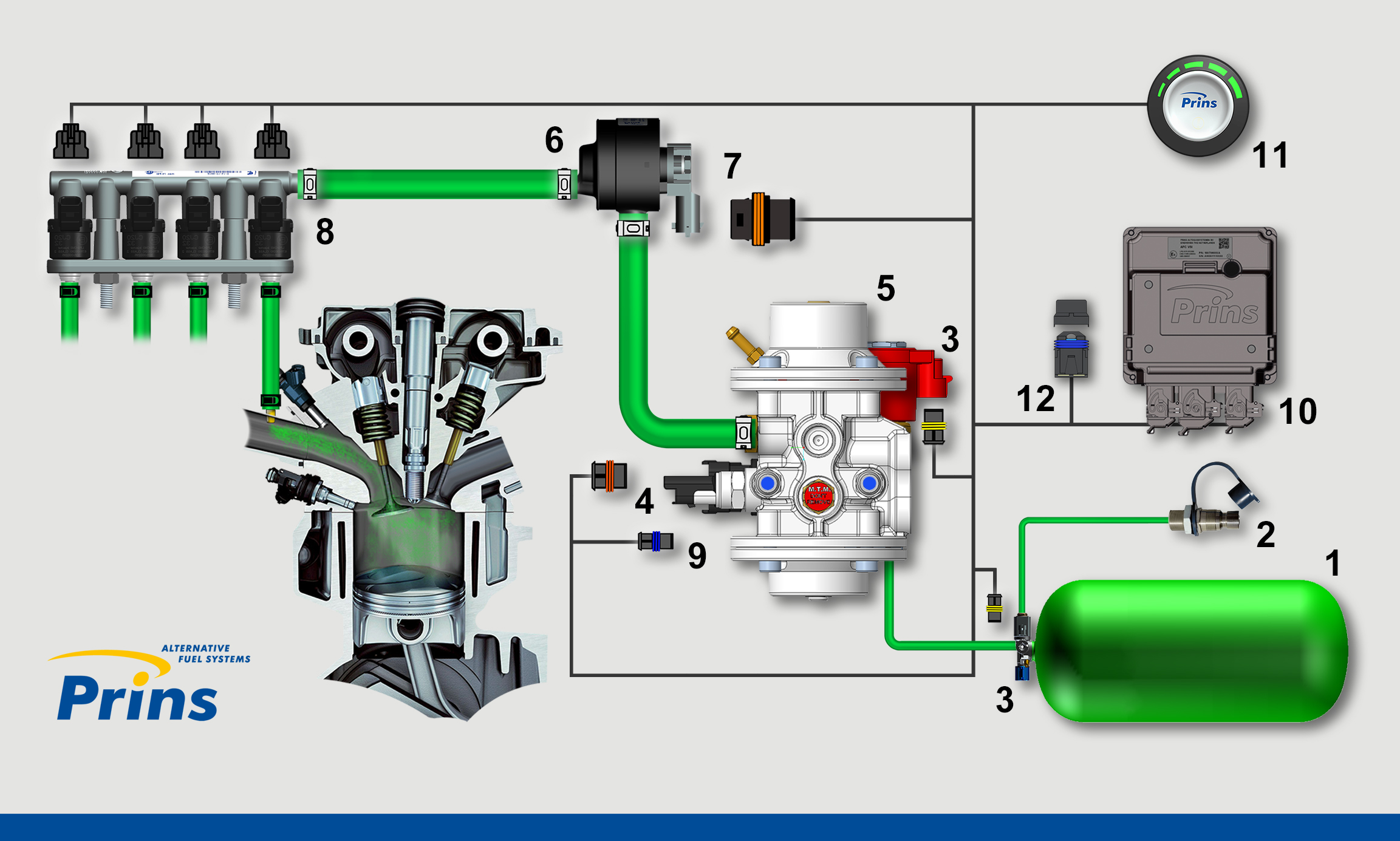
- Your VSI system may differ from this diagram with some adjustments.
1. CNG tank
The CNG tank(s) is most often installed in the boot or under the vehicle. The CNG is stored under high pressure in this storage tank.
2. Filler
The filling point is mounted on the outside of the car or beside the fuel-filling under the fuel filler flap and is provided with a removable protective cover. This must be removed prior to refueling. A non-return valve within the filler prevents the CNG from flowing back after refueling.
3. Solenoid valves
There are two solenoids mounted in the system. One on the tank and one on the high-pressure line in front of the regulator (could also be mounted on the regulator). When switching back to petrol mode, switching off the ignition or in case of an error the flow of CNG will be cut off.
4. Manometer or pressure sensor
The manometer or a pressure sensor is placed in the high-pressure line of the VSI CNG system. The manometer or the pressure sensor is measuring the system pressure. This is an indication for the tank level.
5. Pressure regulator
The pressure regulator is mounted in the engine compartment. It will reduce the high tank pressure to a stable system working pressure.
6. Filter Unit
The filter unit is installed between the regulator and the injector rail. The filter unit filters the pollution from the dry gas to protect the injectors. The filter unit is equipped with a pressure/temperature sensor.
7. Pressure / temperature sensor
The sensor measures the pressure and the temperature of the gas.
8. Injector rail
The injector rail is installed close to the inlet manifold. The injector rail contains the injectors that inject natural gas sequentially.
9. Temperature sensor
The temperature sensor measures the engine’s coolant temperature. The switch over time at cold engine temperature is calculated by the temperature sensor signal.
10. VSI Computer
The VSI computer is in the engine compartment. This VSI computer is the center of the installation and processes all incoming signals and drives the different actuators.
11. Fuel selector switch
The fuel selector switch is located on the dashboard or on the center console. With the switch you operate the VSI CNG system.
12. Fuse
The fuse is located in an available place in the engine compartment. The fuse protects the electronic circuit from overloading.
OPERATING THE PRINS VSI CNG SYSTEM
Starting
Starting
The engine always starts with petrol. Depending on the engine temperature and after the system check, the VSI CNG system will automatically switch over to CNG.
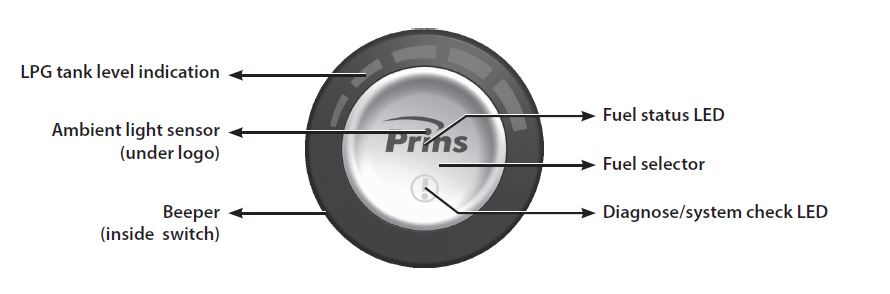
The fuel selector switch
The fuel selector switch has two selection modes:
1. Petrol mode: System LED extinguished (Prins logo)
2. CNG mode: System LED illuminated (Prins logo)
The light intensity of the CNG fuel level indication LEDs varies, depending on the amount of daylight.
Switching from petrol to CNG and reverse
While driving, you can always switch between both fuels by pressing the fuel selector switch. After pressing the fuel selector switch the switch over procedure will be started.
Petrol>> CNG: Fuel status LED flashes. When the system has finished the switch-over procedure the fuel status LED will be illuminated constantly.
CNG>>Petrol: Fuel status LED will be extinguished when the system has switched over to petrol.
CNG fuel level indication
An indication of the fuel level is shown by five LEDs. Depending on the pressure sensor or manometer the fuel level indication will be displayed in 5 or 6 stages. If the red LED is illuminated (low level), the last kilograms of CNG are being used. This means that the tank is not yet completely empty and that there are still some kilograms of CNG remaining, depending on the size and shape of the CNG tank placed in your car. Because of the measuring principle of the system, this measurement cannot be any more accurate. It is only an indication of the fuel tank contents. Experience will show how much further you can drive if the red LED is illuminated.
Empty tank situation
During a tank empty situation, the VSI CNG system switches back to petrol automatically, the fuel status LED flashes and the buzzer beeps 3 times. By pressing the fuel selector switch you confirm the system switches back to petrol. The fuel status LED extinguishes, and the red LED is illuminated (low level). As soon as the CNG tank is filled up with CNG it is possible to switch over to CNG-mode again by pressing the fuel selector switch.
Diagnosis
A diagnosis/system check LED and buzzer are integrated into the switch for diagnostic purposes. The following error messages may occur:
1. Not critical system error:
Diagnosis/system check LED flashes.
Diagnosis: An error has occurred in the VSI CNG system. It is still safe to drive on CNG, even from an environmental point of view. Driving comfort may be reduced.
Action: Consult your Prins dealer.
2. Critical system error:
The system automatically switches back to Petrol-mode, the beeper will be activated and the diagnose/system check LED illuminated constantly.
Diagnosis: An error has occurred in the VSI CNG system. It is not safe to drive on CNG. Therefore, the system will automatically switch to petrol.
Action: Switch off the buzzer by pressing the fuel selector switch.
Consult your Prins dealer.
REFUELLING
Filling the CNG tank must be done as follows:
-- Turn off the engine!
-- Remove filler cap from filler opening, clean it and then start filling.
-- Click fuel pistol in filler opening.
-- Press CNG pump button. When the pump stops after a while, the maximum tank pressure is reached. Stop refueling by releasing the button.
-- Now remove the fuel pistol.
-- Put the filler cap in place to prevent dirt, water, sand and dust from entering the filler opening and therefore the entire system.
Attention: smoking and open flames are prohibited while filling the CNG tank. Also, your cell phone must be shut off.
We strongly recommend adding one bottle of Prins Injector Care to every 50 liters / 13 gallons of petrol, preferably prior to each refill of the petrol tank (approx. every 10.000km/6.200mi). The instruction manual can be downloaded from the website: www.prinsautogas.com.
VSI CNG systems for Direct Injection engines
If your car is equipped with a Direct Injection engine you must bear in mind there will always be a little petrol consumption while driving on CNG.
SAFETY ASPECTS
Disassembly of parts/system
Do not attempt under any circumstances to disconnect or disassemble VSI CNG system components. The system contains high pressurized gas. You run the risk of serious burns when doing this. Only have an approved Prins dealer remove or repair the system.
Gas leakage
If you smell CNG, switch back to petrol and contact an approved Prins dealer immediately.
Fire
In the case of a fire, leave the vehicle and take distance. The CNG tank is equipped with a safety valve that allows the CNG to escape from the tank in case of abnormal pressure inside this tank. Thanks to this device it is impossible for the CNG tank to explode. Always inform the emergency services that you have a VSI CNG system in the vehicle.
MAINTENANCE
When you drive on CNG, maintaining your car is even more important than when using petrol. Since the specifications of CNG differ from those of petrol, minor engine problems which won’t disturb the driving comfort while using petrol, may cause major problems while using CNG. Follow the maintenance instructions to use CNG without any problem.
• General maintenance to the car regarding spark plugs, spark plug cables, ignition circuit, valves, etc., must be carried out according to the instructions of the car manufacturer.
• Proof of maintenance according to the guidelines of the importer is obligatory (completely filled in maintenance booklet).
• Maintenance must be carried out by a authorized dealer by the importer.
• Adjustments and repairs on your Prins VSI CNG system should only be carried out by a Prins authorized dealer.
We recommend having a maintenance check performed every 25,000 km or every two years by an official Prins CNG installer. The items of this maintenance check can be found in the table below:
TROUBLESHOOTING
If your car won’t run on CNG, follow the next checklist:
• Is there enough CNG in the tank? (minimum 20 bar!)
• Is there enough petrol in the tank to start on petrol?
• Is the fuse in the VSI CNG system defective (near the CNG computer)?
Never use a heavier fuse than indicated on the fuse wire. This may cause damage to the system.
If you cannot solve the problem yourself, please contact your Prins dealer. Do not carry out any repairs yourself but have this done by an authorized Prins dealer. Otherwise, the warranty on your Prins VSI CNG system will no longer be valid.
GENERAL DIRECTIVE FOR DAMAGE REPAIRS IN SPRAY/DRY BOOTHS
When a vehicle with a VSI CNG system is dismantled, be careful with the CNG tank, including pipes, due to possible remaining pressure in these parts. Also remove CNG tank before the vehicle is crushed.
GENERAL DIRECTIVE FOR EXTREME TEMPERATURES
Extreme temperatures and fuel composition can influence the operation of the VSI CNG system. It may take longer for the system to switch from petrol to gas. In extreme situations the system may switch back to petrol, because the minimum conditions for the proper system operation are not met.
CNG FUEL QUALITY
Natural gas must be as specified in the SAE J1616 or ISO 15403:2005 regulation at a minimum, with a methane concentration of at least 85%. If a fuel quality other than specified is used, all terms of guarantee become void.
Warranty
14.1 Prins warrants that the Products it supplies are manufactured from sound materials and are of sound workmanship. Should defects nonetheless occur in the Products supplied by Prins as a result of manufacturing defects and/or defects in the material, Prins will, after examining the defects in accordance with Article 14.3, repair the said defects, or cause them to be repaired, within the specified term, or provide the components required for repair, or cause them to be provided, replace the Products in full or in part, or reimburse at most the invoice value of the Products, all this at its sole discretion. This warranty shall apply during twenty four (24) months following delivery.
14.2 Should the Product supplied comprise a complete CNG system, this must have been built in by Prins or by a dealer approved by Prins in accordance with the standard instructions and the statutory requirements; if the system will be registered online (warranty portal) within thirty (30) days of delivery, the warranty period referred to in Article 14.1 shall be thirty six (36) months, subject to written deviations. If no online registration (warranty portal) will be examined, the guaranty term of twenty-four twenty four (24) months will start on the delivery date.
14.3 At the request of Prins, the Purchaser shall allow an expert appointed by Prins to examine the defective Product, failing which the right to warranty shall lapse. The decision of the expert shall be binding for both parties. The costs of such expert appraisal shall be borne by Prins if the Purchaser has made a claim under the warranty; they shall otherwise be at the expense of the Purchaser.
14.4 Any claims under this warranty shall be reported to Prins by registered letter within eight (8) days of their occurring. Should the complaint not be submitted within that period, any claim vis-à-vis Prins shall lapse. Any legal proceedings instituted in respect thereof shall be brought before the court within thirteen (13) months of the submission of the timely complaint on pain of their lapsing.
14.5 Should the Purchaser request Prins to repair the Products at the Purchaser’s premises, Prins shall be authorized to invoice the Purchaser for the costs incurred, including travel expenses, accommodation and meals.
14.6 Defects resulting in whole or in part from the following shall not in any case be covered by the warranty:
(a) failure to comply with the directions for use, operating instructions etc. or use other than the intended normal use;
(b) normal wear and tear;
(c) alterations to the information on the warranty card;
(d) alterations to information on the stickers provided by Prins in accordance with its legal requirements;
(e) assembly/installation, repairs or adjustment by third parties, or in any case by a dealer or purchaser not recognized by Prins without Prins’s prior written consent;
(f) the application of any government regulation on the nature or quality of materials used;
(g) materials provided by the Purchaser to Prins to process or execute an order, unless explicitly or otherwise agreed;
(h) materials and/or goods used in consultation with the Purchaser;
(i) advice given by Prins, unless explicitly agreed otherwise;
(j) the processing of Products by the Purchaser, unless Prins explicitly states a specific manner of processing in writing in its documentation brochures etc. or has permitted such without any reservation in writing;
(k) external influences, installation mistakes;
(l) incorrect fuel or fuel of inferior quality;
(m) the use of an additive not approved in writing by Prins;
(n) demonstrable failure to comply with the maintenance schedule prescribed by the car manufacturer, importer and/or Prins.
14.7 Prins shall not be held to any warranty, nor shall it be liable to pay any compensation whatsoever with regard to the Contract should the Purchaser fail to comply with any obligation arising for it from the Contract concluded with Prins or from a related contract, or fail to do so properly or on time.
14.8 Any claim under this Article shall expire should the Purchaser carry out repairs, disassembly or other actions affecting the Products, or should it cause such repairs, disassembly or other actions to be carried out, without Prins’s prior written consent.
14.9 Should Prins replace any components or Products in fulfilment of a warranty obligation, such Products or components shall become its property. Prins shall be authorized to charge transport costs for these Products or components unless Prins has given instructions for the transport.
14.10 Without prejudice to the provisions of Article 15, Prins shall in no case be bound by any other obligation, for example to pay compensation.
Liability
15.11 Prins shall not be liable for any costs, damage or the like that may arise as a direct or indirect result of:
(a) force majeure, as set forth in these conditions;
(b) acts or omissions by the Purchaser, its employees, or other persons who have been put to work by the Purchaser or on its behalf;
(c) the applicability of one of the circumstances specified in Article 14.6.
15.12 Prins shall only be liable to the extent of its insurance cover for any damage (or personal damage) to Products or property belonging to the Purchaser and/or third parties if such has occurred through any intentional act or omission or gross negligence on the part of Prins or of those who have been put to work by Prins, with the amount insured by Prins being the maximum. Should it turn out, for whatever reason, that no insurance cover exists with respect to a given case, Prins’s liability shall be limited to the invoice value, exclusive of VAT.
15.13 Prins shall in no case be liable for any collateral damage suffered by the Purchaser or a third party, including consequential damage, immaterial damage, loss of profits or environmental damage.
15.14 The Purchaser indemnifies Prins against all claims by third parties in respect of deliveries of Products.