
Dear customer,
Thank you for choosing the advanced Prins VSI System for your car! This system complies with strict European standards covering safety and the environment.
It is important that you read and understand this manual.
This digital manual gives you general information about Autogas (LPG), and explains the Prins VSI system. Scroll down further for information about the fuel selector switch, refuelling LPG, fuel consumption, safety aspects, maintenance, troubleshooting, general directives and the warranty terms.

General information for driving on LPG (Autogas)
1. As the VSI system starts on petrol, make sure that the fuel tank is not empty or nearly empty. This also prevents the fuel pump from running dry, which could lead to damage to the pump. The petrol in the tank should not be more than 3 months old.
2. For a guaranteed life span and optimal driveability of the VSI system it is necessary to follow the prescribed maintenance. We advise a maintenance check for the VSI system at an official Prins installer every 25.000 km or every two years. Check below to find the items for maintenance check.
3. When you smell gas in or around your car, immediately switch over to petrol and have your car checked at the nearest Prins LPG service point.
4. After the installation of your Prins system, you will receive a warranty certificate from your installer. This warranty certificate contains all information about your car and your Prins system. The warranty period starts on the day of conversion.
5. It is generally allowed for LPG vehicles to drive and park in an underground parking space. In some parking spaces there are restrictions imposed by the owner. The owner of the parking space may do that by placing signs at the entrance. These signs have to be respected.
AUTOGAS
Autogas or LPG (Liquefied Petroleum Gas) is in most countries a combination of propane gas and butane gas. LPG is produced during the extracting and refining of oil (petroleum) and natural gas. In its natural state it is gaseous but it is stored, under pressure, as a liquid in the LPG tank. LPG is a cleaner fuel than for example petrol or diesel. The use of LPG helps to improve air quality. It is an odourless gas, but to make it easier to identify for example a leak, an odour has been added to it.
The Prins VSI LPG system
VSI is short for Vapour Sequential Injection. The VSI LPG system is based on the sequential injection of vaporous LPG into the engine. ‘Sequential’ means that the LPG injectors apply the LPG in a specific order or sequence which equals the injection sequence of petrol injectors. The system also allows a more precise injection of the mixture, thus complying with the tightened emission regulations. The VSI LPG system is equivalent to the original petrol injection technology and makes optimum use of the electronics already present in your vehicle. With the Prins VSI LPG system you will experience no difference between driving using LPG or petrol.
No noticeable difference compared to running your vehicle on petrol!
The components that make up our VSI LPG-system are shown below. The main components meet the same standards as OEM-parts, and have been specifically developed for LPG and CNG systems. They satisfy the most demanding regulations and certification standards.
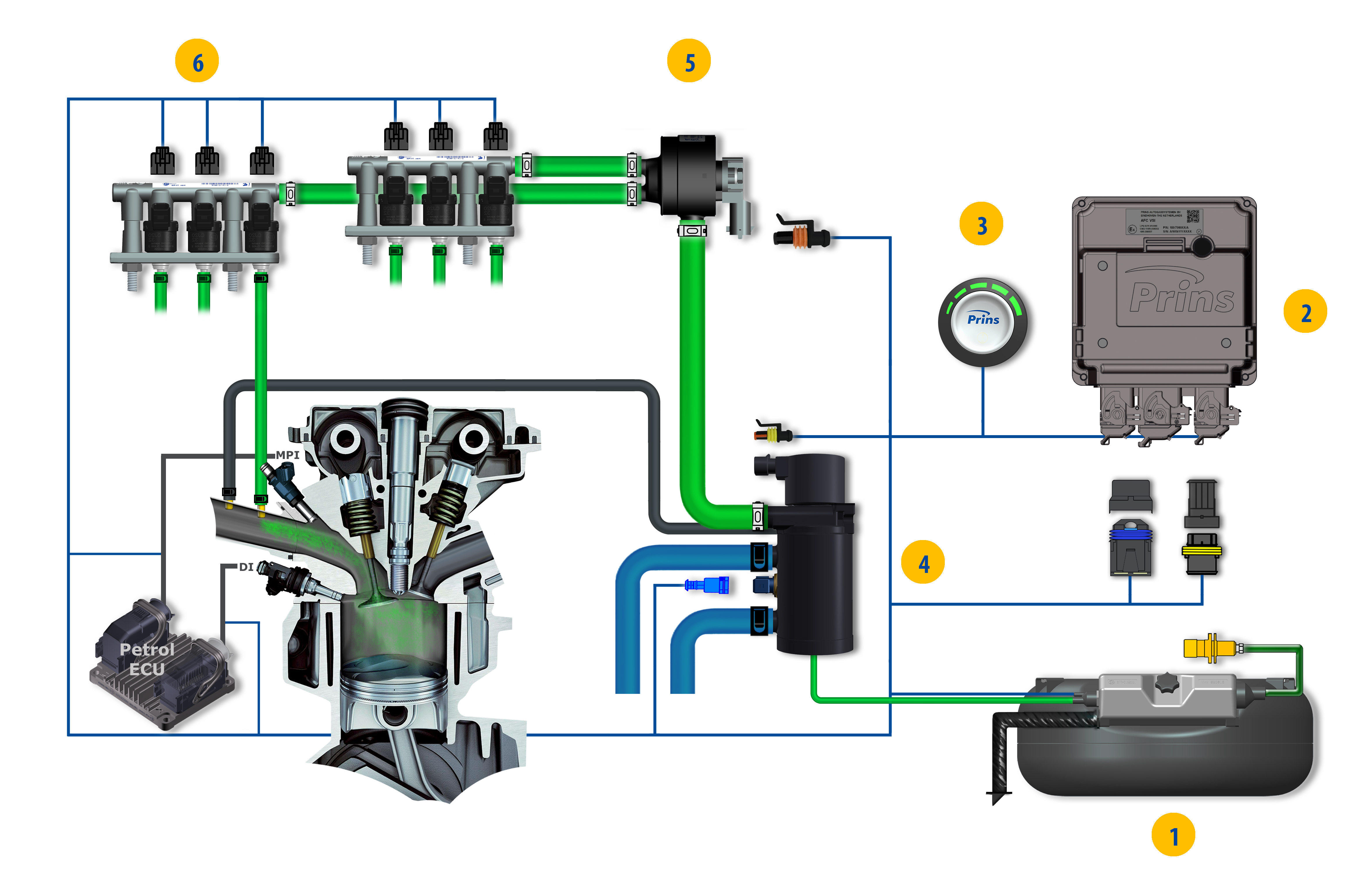
*This system lay-out is for 'VSI-3 DI' . It may deviate from your actual LPG system and is for reference only.
1. LPG tank
Liquefied petroleum gas tank
The LPG tank takes most often the place of the spare wheel, in the boot or under the vehicle. The LPG is stored under pressure in the storage tank. The tank is equipped with various safety appendages.
Filler
The filling point is mounted on the outside of the car or beside the fuel-filling under the fuel filler flap and is provided with a removable protective cover. This must be removed prior to refuelling. A non-return valve prevents the LPG from flowing back after refuelling.
LPG solenoid valves
There is one solenoid on the tank. When switching back to petrol mode, switching off the ignition or in case of an error the flow of LPG will be cut off.
Tank sender
The tank sender is mounted in the LPG tank. The tank sender is an electrical device which measures the fluid level in the tank.
2. AFC-3.0 DI computer
The AFC-3.0 DI computer is located in the engine compartment. The computer is the centre of the LPG installation that processes all incoming signals and drives the different actuators.
3. Fuel selector switch
The fuel selector switch is located on the dashboard or on the centre console. With the switch you operate the VSI system.
4. eVP-500 Reducer/regulator
eVP-500 reducer/regulator
The electronic controlled eVP-500 reducer is mounted in the engine compartment. The eVP-500 transforms the LPG from a liquid state into a vapour state, and will reduce the tank pressure to a variable system working pressure.
Temperature sensor
The temperature sensor is fitted into the reducer and measures the coolant temperature in the reducer. The temperature sensor sets the switch over moment of the system.
Actuator + filter
This part has three different functions. 1) It electronically controls the dynamic pressure of the LPG. 2) It cuts off the flow of LPG automatically when switching to petrol mode, switching off the ignition, or in case of an error. 3) In the same time it filters the LPG.
5. Filter unit
Filter unit
The filter unit is fitted between the reducer and the injector rail. The filter unit is filtering the pollution from the dry gas to protect the injectors.
Pressure / temperature sensor
The filter unit is equipped with a pressure/temperature sensor. The sensor measures the pressure and the temperature of the gas.
6. Injector rail
Injector rail
The injector rail is fitted close to the inlet manifold. The injector rail consists of injectors which are metering the supply of vapourized LPG sequential into the engine.
Fuses
The fuses are located in an available place in the engine compartment. The fuses protect the electronic circuit from overloading.
Information on specific subjects
Operating the Prins VSI LPG system
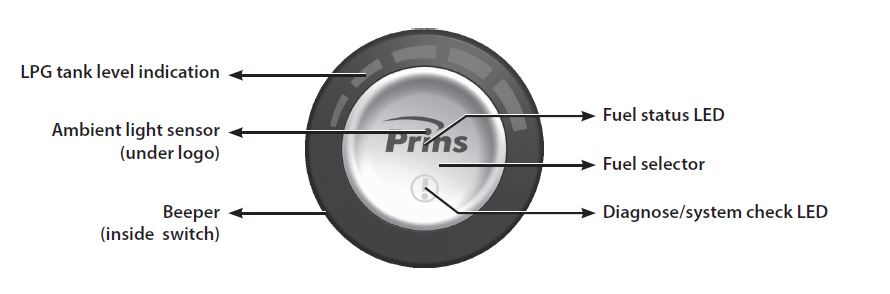
Starting
The engine always starts on petrol. Depending on the engine temperature and after the system check, the VSI system will automatically switch over to LPG.
The fuel selector switch
The fuel selector switch has two selection modes:
1. Petrol mode: System LED extinguished (Prins logo)
2. LPG mode: System LED illuminated (Prins logo)
The light intensity of the LPG fuel level indication LEDs varies, depending on the amount of daylight.
Switching from petrol to LPG and reverse
While driving, you can always switch between both fuels by pressing the fuel selector switch. After pressing the fuel selector switch the switch over prodedure will be started.
Petrol>>LPG: The Fuel status LED flashes. When the system has finished the switch over prodedure the Fuel status LED will be illuminated constantly.
LPG>>Petrol: The Fuel status LED will be extinguished when the system has switched over to petrol.
LPG fuel level indication
An indication of the fuel level is shown by five LEDs. Depending on the tank sensor used the fuel level indication will be displayed in 5 or
6 stages. If the red LED is illuminated (low level), the last litres of LPG are being used. This means that the tank is not yet completely empty and that there are still some litres of LPG remaining, depending on the size and shape of the LPG tank placed in your car. Because of the measuring principle of the system measuring the fuel level, this measurement cannot be any more accurate. It is only an indication of the fuel tank contents. Experience will show how much further you can drive if the red LED is illuminated.
Empty tank situation
During a tank empty situation the VSI switches back to petrol automatically, the fuel status LED flashes and the buzzer beeps 3 times. By pressing the fuel selector switch you confirm the system switches back to petrol. The fuel status LED extinguishes and the red LED is illuminated (low level). As soon as the LPG tank is filled up with LPG it is possible to switch over to LPG-mode again by pressing the fuel selector switch.
Diagnosis
A diagnose/system check LED and buzzer are integrated into the switch for diagnostic purposes. The following error messages may occur:
1. Not critical system error: the diagnose/system check LED flashes.
Diagnosis: An error has occurred in the VSI LPG system. It is still safe to drive on LPG, even from an environmental point of view. The driving comfort may be reduced.
Action: Consult your Prins dealer.
2. Critical system error: System automatically switches back to Petrol-model, the beeper will be activated and the diagnose/system check LED is illuminated constantly.
Diagnosis: An error has occurred in the LPG system. It is not safe to drive on LPG. Therefore, the system will automatically switch to petrol.
Action: Switch off buzzer by pressing the fuel selector switch.
Consult your Prins dealer.
Refuelling LPG
Filling the LPG tank:
Step 1: Turn off the engine!
Step 2: Remove filler cap from filler opening.
Step 3: There are four different types of fillers:
Bayonet filler: place fuel pistol in filler opening and turn it a quarter to the right or left. Pull the fuel pistol handle.
Euro filler: tighten fuel pistol nut on filler opening. Press handle on fuel pistol.
Italian filler: place fuel pistol in filler opening. Press handle on fuel pistol.
Euro Nozzle filler: place fuel pistol in filler opening. Press handle on fuel pistol.
Step 4: Press LPG pump button. When the pump stops after a while, the maximum tank level of 80% is reached. Stop refuelling by releasing the button.
Step 5: Now loosen the handle (some LPG may be released) and remove the fuel pistol.
Step 6: Put the filler cap in place to avoid dirt, water, sand and dust from entering the filler opening and therefore the entire system.
Attention: smoking and open flame are prohibited while filling the LPG tank. Also your cell phone must be shut off.
We strongly recommend adding one bottle of Prins InjectorCare (200ml) to every 30 liters (8 gallons) of petrol, preferably prior to each refill of the petrol tank (approx. every 10.000km/6.200mi).
The instruction manual can be downloaded here.
Fuel consumption
LPG has a lower energy value per volume unit than petrol. Therefore the consumption when using LPG will be approximately 15-25% (depends on the ratio of propane to butane of the LPG you have refueled with) higher than the consumption you are used to get with petrol.
LPG systems for Direct Injection engines
If your car is equipped with a VSI-DI system you have to bear in mind there will always be a little petrol consumption during driving on LPG.
Safety aspects
Disassembly of parts/system
Do not attempt under any circumstances to disconnect or disassemble LPG system components. The system is pressurized and contains liquid gas. You run the risk of serious burns when doing this. Only have an approved Prins dealer remove or repair the system.
Gas leakage
If you can smell LPG, switch back to petrol and contact an approved Prins dealer immediately.
Fire
In the case of a fire, leave the vehicle and take distance. The LPG tank is equipped with a safety valve that allows the LPG to escape from the tank in case of abnormal pressures inside this tank. Thanks to this device it is impossible for the LPG tank to explode. Always inform the emergency services that you have a LPG system in the vehicle.
Maintenance
When you drive on LPG, maintaining your car is even more important than when using petrol. Since the specifications of LPG differ from those of petrol, minor engine problems which won’t disturb the driving comfort while using petrol, may cause major problems while using LPG.
Follow the maintenance instructions in order to use LPG without any problem.
• General maintenance to the car regarding spark plugs, spark plug cables, ignition circuit, valves, etc., has to be carried out according to the instructions of the car manufacturer.
• Proof of maintenance according to the guidelines of the importer is obligatory.
• Maintenance has to be carried out by a dealer authorised by the importer.
• Adjustments and repairs on your Prins LPG system should only be carried out by a dealer authorised by Prins.
We advise a maintenance check for the VSI system at an authorised Prins installer every 25.000 km or every two years. These are the items included in the maintenance check:
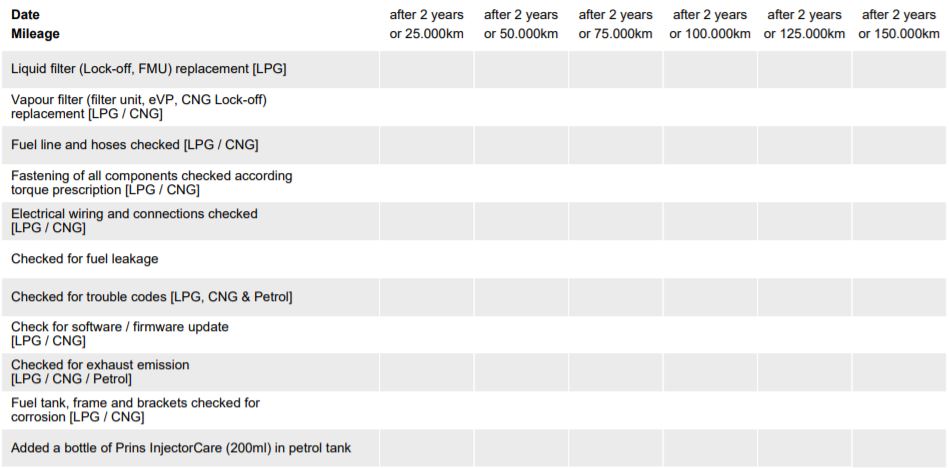
Troubleshooting
If your car won’t run on LPG, follow the next checklist:
• Is there enough LPG in the tank?
• Is there enough petrol in the tank for starting on petrol?
• Is a fuse in the VSI LPG system defective (near LPG computer)?
Never use a heavier fuse than indicated on the fuse wire. This may cause damage to the system.
If you cannot solve the problem yourself, please contact your Prins dealer. Do not carry out any repairs or readjustments yourself, but have this done by an authorised Prins Dealer, Otherwise, the warranty on your Prins VSI LPG system will no longer be valid.
Diagnosis of the Fuel Selector Switch
A diagnose/system check LED and buzzer are integrated into the switch for diagnostic purposes. The following error messages may occur:
1. Not critical system error: the diagnose/system check LED flashes.
Diagnosis: An error has occurred in the VSI LPG system. It is still safe to drive on LPG, even from an environmental point of view. The driving comfort may be reduced.
Action: Consult your Prins dealer.
2. Critical system error: System automatically switches back to Petrol-model, the beeper will be activated and the diagnose/system check LED is illuminated constantly.
Diagnosis: An error has occurred in the LPG system. It is not safe to drive on LPG. Therefore, the system will automatically switch to petrol.
Action: Switch off buzzer by pressing the fuel selector switch.
Consult your Prins dealer.
General directives
General directive for damage repairs in spray/dry booths
In case of damage repairs to a car with an LPG system, the LPG tank must be removed when the car is placed in a spray/dry booth with a drying temperature higher than 60°C. Otherwise, the opening pressure of the overpressure safety valve will be exceeded.
General directive for dismantling LPG system
When a vehicle with an LPG system is dismantled, be careful with the LPG tank, including pipes, due to possible remaining pressure in these parts. Also remove LPG tank before the vehicle is crushed.
General directive for extreme temperatures
Extreme temperatures and the fuel composition can influence the operation of the LPG system. It may take longer for the system to switch from petrol to gas. In extreme situations the system may switch back to petrol, because the minimum conditions for the proper system operation are not met.
LPG fuel quality
The LPG must be as specified in the DIN EN 589 regulation at a minimum. If a fuel quality other than specified is used, all terms of guarantee become void.
Complementair ValveCare system
ValveCare
General information:
The ValveCare system is a full electronic sequential regulated additive dosing system suitable for direct injected and port gas injected engines. ValveCare is used for the correct dosage of additives which prevent excessive valve and valve seat wear. These additives are added to petrol, but not to LPG/CNG. In combination with the highly effective Prins additive, the system will contribute to a cleaner combustion chamber and improved durability of valves and valve-seats against excessive wear.
Diagnosis:
The additive ValveCare has a consumption ratio of 1 liter additive on 1.000 liter LPG. The additive-reservoir can be refilled at any time. In case the additive reservoir is empty, the Prins switch will indicate a blue exclamation mark (blinking), and the engine can run another 4 hours on LPG. After this period the engine does only run on petrol and the exclamation mark will stay visible. Filling up the additive-reservoir will make driving on LPG possible again.
What you need to know:
• One bottle of ValveCare (1L) is sufficient for approx. 1.000 liter fuel.
• Do not use or mix other additive with the original Blue Prins ValveCare additive. Use of other additive can harm the system and warranty will directly expire.
• For more information please contact your official Prins installer.